
Zarina

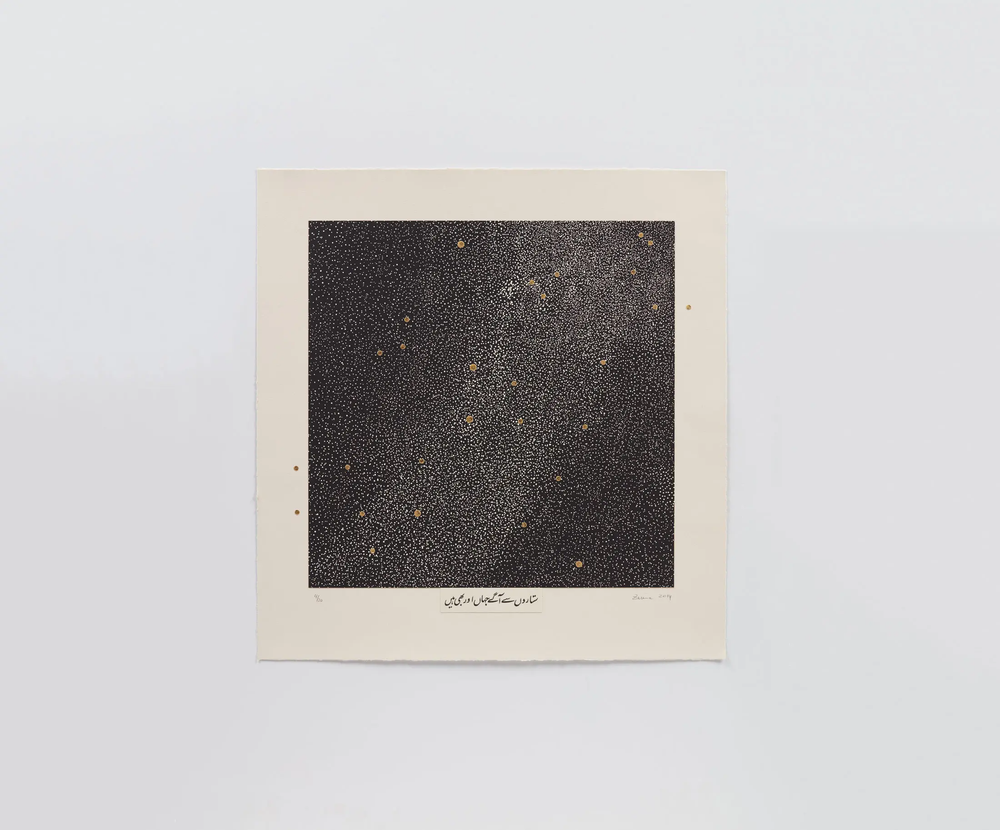
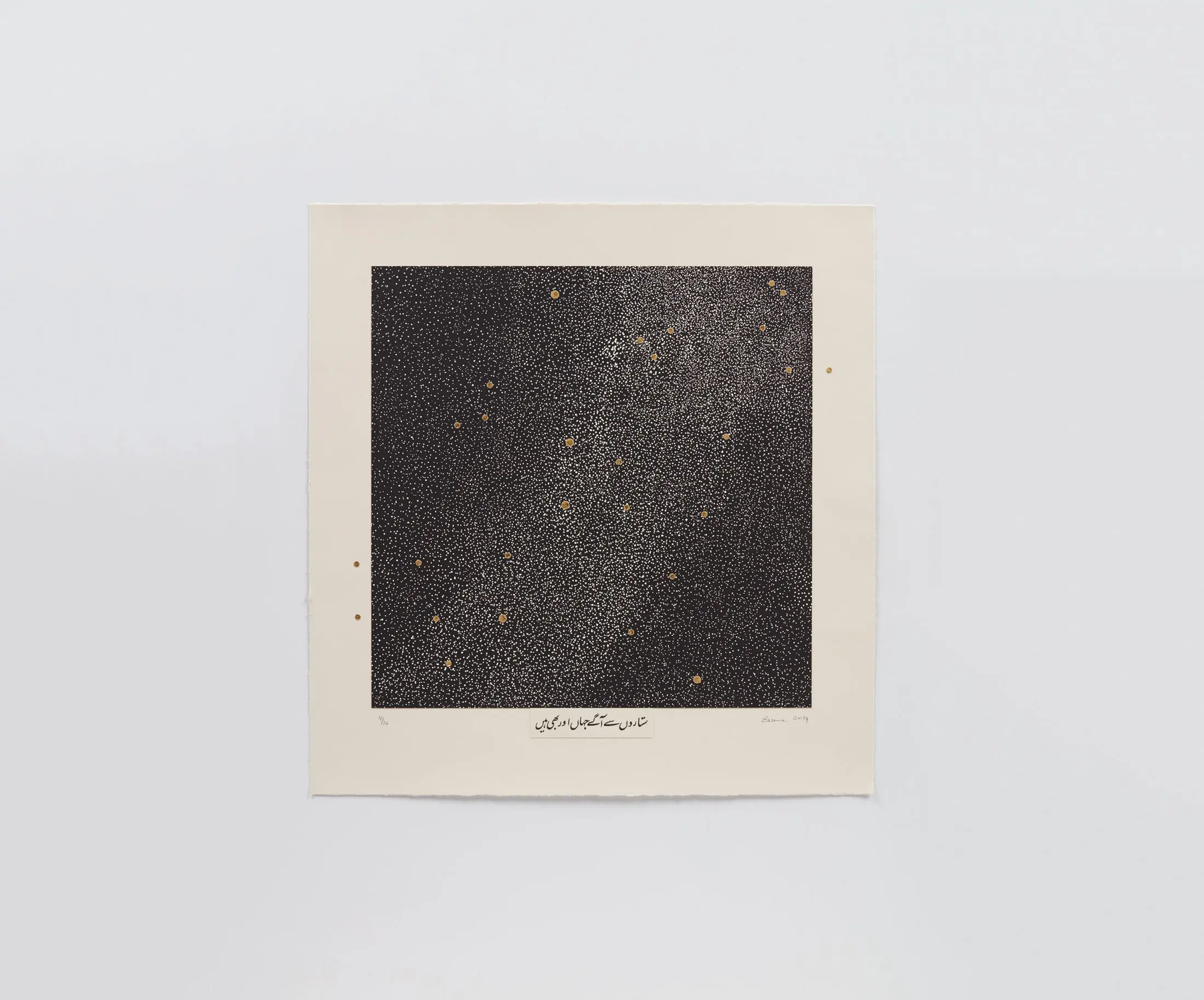
Zarina, Beyond the Stars, 2014. Woodcut printed on BFK light paper collaged with 22-carat gold leaf and Urdu text mounted on Somerset Antique paper
There is a lexicon of “home” that plays out across scale. At its broadest, this might include the vocabulary of one’s nation, its iconography, its rituals, smells, tastes, and sounds. Then there are the patterns specific to our individual dwellings—the song of footsteps that tells us which family member is walking down the stairs, an old stain on a rug that heralds a thick narrative, or a sudden, blanketing silence that may dictate whether it’s safe to leave our bedroom. Zarina, the Indian-born, New York-based artist who died in 2020 at eighty-two, spent a lifetime developing her own vernacular through several bodies of relatively quiet, rhythmic work that manage to ask what it is we may be longing for when we’re longing for home. At first blush, the visual language she established might appear to be one chiefly concerned with materiality and restrained form, but it rewards further attention by expanding outward into the artist’s personal dialect of belonging. Serial works that can read as explorations of composition, geometry, and material processes—her early training in mathematics and her consideration of a career in architecture may offer some clue to these predilections—do reward on those formal planes, and handsomely so, but they also prove to be moving inquiries into how our senses of self are formed, fractured, and continuous over time.
As evidenced by the work included in Luhring Augustine’s posthumous mini-retrospective Beyond the Stars, home, for Zarina, was often an itinerant’s home, one of dislocation, fracture, and all the longing that distance holds. Born in Aligarh, India, Zarina was ten years old at the time of the 1947 Partition. Her family briefly moved to the new country of Pakistan before returning to Aligarh after the political upheaval had subsided. At twenty-one years old, she married a diplomat and the two lived together in Thailand, France, Germany, and New Delhi before moving to New York in 1976. Her husband died unexpectedly the following year, at which point the artist decided to stay in New York (short stints in Santa Cruz and Los Angeles notwithstanding), where she remained until shortly before her death. Two woodcuts in the show, Dividing Line (2001) and Abyss (2013), explicitly render the border demarcated by the British between India and Pakistan during the Partition. In the earlier work, Zarina carved out the negative space around a jagged line that represents the border, creating the image of a long border line floating on the page amidst the printing block’s remnant hash marks. In the latter piece, she returned a dozen years later to create an inverse composition, carving the border’s form from the block so it’s rendered as a white mark cut into solid black.
Read full article at brooklynrail.org
