Luhring Augustine is delighted to announce a solo exhibition of work by Zarina (1937–2020), opening in our Tribeca location on January 16 and remaining on view through March 28. Marking the gallery’s first show of the artist’s work since her death, and the first in the Tribeca gallery, this presentation represents a milestone for the establishment of Zarina’s estate. Featuring works that span the artist’s seven-decade career, the exhibition highlights the breadth and enduring relevance of her artistic vision, bringing together works across a range of media from woodcut, collage, and print portfolios, to cast-paper and other sculptural pieces.
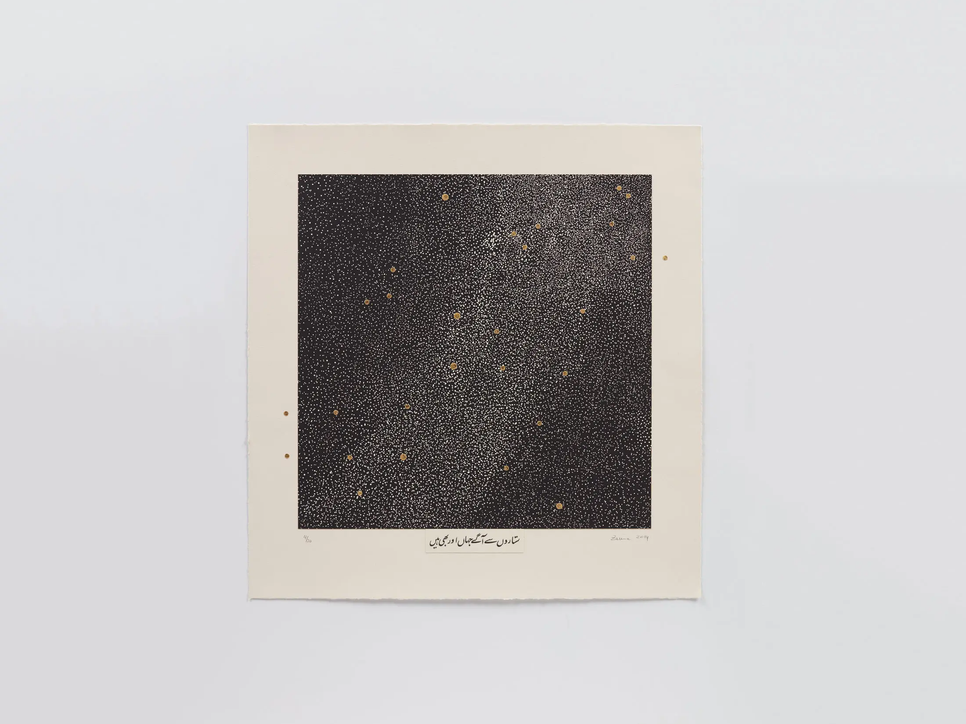
Zarina’s work engages deeply with the history, politics, and culture of the twentieth century. Born in Aligarh, India, she traveled extensively and trained in printing techniques in Bangkok, Paris, and Tokyo before settling in New York. Connecting intimate experiences to global histories, her singular voice was shaped by her peripatetic lifestyle that was lived between languages, geographies, and cultures. She returned repeatedly to language as inspiration and source for her work, such as in the print that lends its title to the exhibition, Beyond the Stars (2014). She often employed her native Urdu as a tool for “…inviting emotional responses that lead to reflection and self-reflection…that catalyze the process of becoming aware of ourselves and our place in the world.” Simultaneously, her visual vocabulary, in which line, geometry, and material carried profound emotional and conceptual weight, remained rigorously distilled throughout her career.
Foundational works, such as the woodcut Wall II (1969), reveal Zarina’s commitment to line and her practice of carving directly into a woodblock or plate, a process she described as an extension of drawing itself. Her engagement with borders, displacement, and personal geography emerges in prints from the 1990s and early 2000s, which transform cartographic line into abstract form. The iconic work Dividing Line (1991) is a distillation of this approach: a jagged black line, representing the India–Pakistan border determined during the partition of 1947, cuts boldly across the paper, achieved through Zarina’s rigorous removal of the negative space carved on either side of this edge.
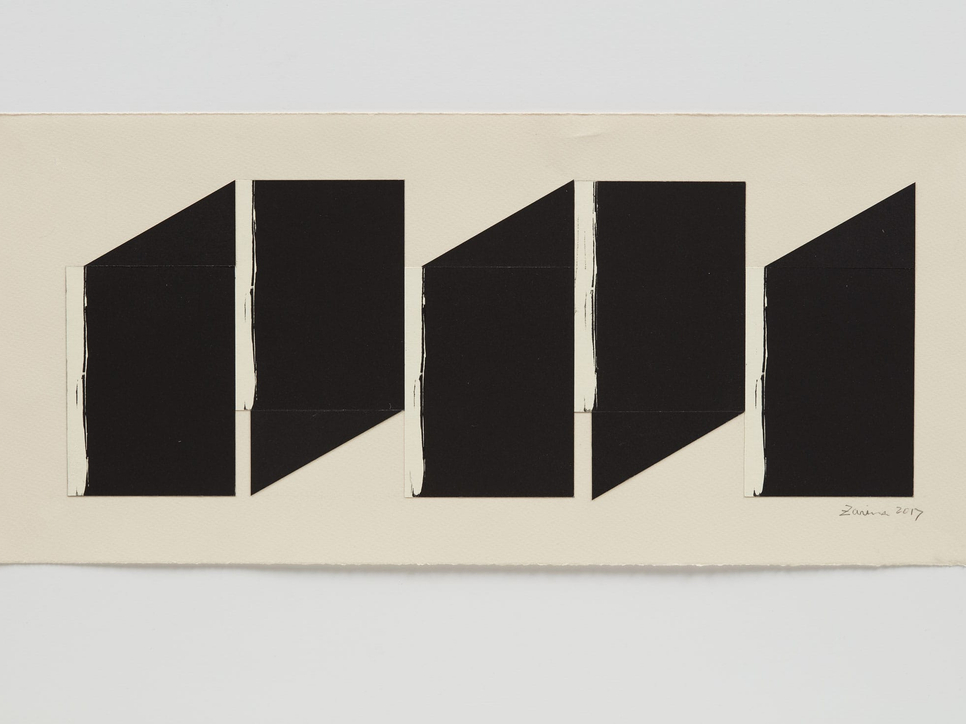
In the late 1970s, she began exploring cast paper as both surface and structure, producing sculptural works such as Marrakesh (1988), in which texture and pigment evoke remnants of place, architectural surfaces, or geological strata. Other sculptural works include a number of Tasbih pieces, composed of strings of beads in materials such as wood, marble, or green onyx, that suggest prayer, spirituality, and remembrance. Collages made during the final years of the artist’s life use crushed, cut, and rubbed handmade paper, pewter leaf, gold leaf, and black ink to capture spaces shaped by memory, absence, or transition. A recurring motif that anchors these works, and is a theme that ran through much of Zarina’s work, is that of the house–folding, spinning, shadowed, or fractured.
Over the course of her career, Zarina consistently returned to elemental forms, themes, and materials in order to articulate experiences both personal and shared. This exhibition invites viewers into that conversation, a resonant space where line, form, and language converge to evoke memory, connection, and reflection.
Zarina’s works have been exhibited at numerous venues internationally including representing India at the 2011 Venice Biennale, and her retrospective exhibition entitled Zarina: Paper Like Skin that was presented at the Hammer Museum, Los Angeles in 2012, followed by the Guggenheim, New York as well as the Art Institute of Chicago in 2013. Her work is in the permanent collections of Tate Modern, London; National Gallery of Art, Washington DC; The Metropolitan Museum of Art, New York; Museum of Modern Art, New York; Solomon R. Guggenheim Museum, New York; Whitney Museum of American Art, New York; Hammer Museum, Los Angeles; San Francisco Museum of Modern Art; and The Menil Collection, Houston, among many others. Most recently, she was the subject of solo exhibitions at the Pulitzer Arts Foundation, St. Louis, MO (2019-2020) as well as at the Kiran Nadar Museum of Art, New Delhi, India (2020-2021). Urdu Worlds, a two-person exhibition of Zarina and Ali Kazim's works, curated by Hammad Nasar, will be on view at the Ishara Art Foundation in Dubai from January 16 – May 31, 2026.
[1] Aamir R. Mufti, ‘Zarina’s Language Question’, in Zarina: Paper Like Skin, ed. Allegra Pesenti, Los Angeles, 2012, 158.